A growing body of research indicates that integrating social services into health care delivery can improve health and reduce spending.
Conditions in places where people live, learn, work, and play affect a wide range of health risks and outcomes. These conditions are known as social determinants of health (SDOH).
Poverty limits access to healthy foods and safe neighborhoods. More education is a predictor of better health. Differences in health are striking in communities with poor SDOH such as unstable housing, low income, unsafe neighborhoods, or substandard education. Individual and population health improves by applying what is known about SDOH, and also health equity advances. The importance of addressing SDOH by including “create social and physical environments that promote good health for all” is one of the four overarching goals for the decade.
County Health Rankings—“population health checkup”
- Demonstrate differences in health by place,
- Raise awareness of many factors that influence health, and
- Stimulate community health improvement efforts
Annually since 2010, the University of Wisconsin Population Health Institute and the Robert Wood Johnson Foundation have produced the County Health Rankings—a “population health checkup” for the nation’s over 3,000 counties. The Rankings are based on a conceptual model of population health that includes both health outcomes (mortality and morbidity) and health factors (health behaviors, clinical care, social and economic factors, and the physical environment). Data for over 30 measures available at the county level are assembled from a number of national sources. The County Health Rankings can be used to clearly demonstrate differences in health by place, raise awareness of the many factors that influence health, and stimulate community health improvement efforts. The Rankings draws upon the human instinct to compete by facilitating comparisons between neighboring or peer counties within states. Since no population health model, or rankings based off such models, will ever perfectly describe the health of its population, we encourage users to look to local sources of data to understand more about the health of their community. Source: https://www.ncbi.nlm.nih.gov/pmc/articles/PMC4415342/

County Health Rankings Model.
Visualizing Health Equity as compared to Health Equality – one size does not fit all – per Robert Wood Johnson Foundation:
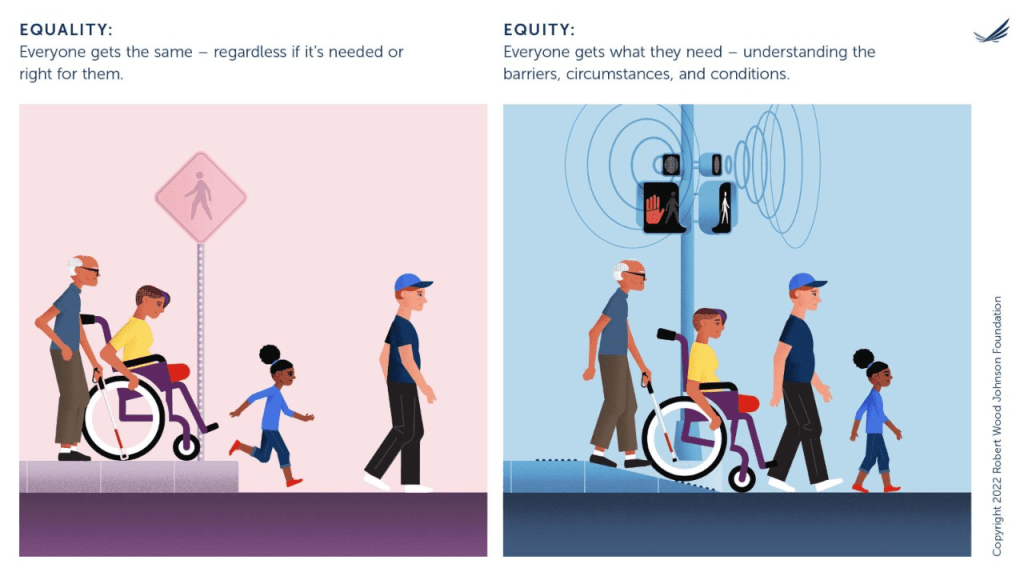
Visualizing Health Equity: One Size Does Not Fit All Infographic by RWJF on RWJF.org
 MedicalPracticeCME.com